WOMEN AT WORK: Getting a fair deal
TOPICS

4:28

2:56

4:50
3:24

3:12
Member Questions
1:26
0:47
1:33
1:17
1:35
Read the transcript
Read the audio transcript from this workshop
Click to read
WOMEN AT WORK
CHAPTER 1 – WHICH LAWS PROTECT WOMEN?
I’m a lawyer. And unfortunately, what that means is that sometimes I talk about really technical things that are pretty boring to everybody else. But when I’m talking about laws, it is important that I spend a little bit of time highlighting where those laws come from and how they might differ for people in different states and territories around Australia.
So in Australia, we have both state and federal laws that deal with protecting people at work from discrimination. And what this means in practical terms is that there are some different protections that apply in different states and territories, and that also for some workplace claims, you go to a state or tribunal or court. For others you’ll go to a federal court or tribunal. So sometimes where you’re actually going for help will change based on where you are. In terms of laws within states and territories. Each state and territory will have laws that deal with discrimination. So in South Australia, Victoria and Western Australia, we have Equal Opportunity Acts. Whereas in the ACT, Northern Territory, New South Wales, Queensland and Tasmania, there are state-based Anti-Discrimination Acts. In general, What all of these laws do around the country, is make it unlawful to discriminate against people for certain reasons in certain places, and that includes things like caring responsibilities, gender, gender identity, marital status, disability, partnership status, pregnancy, race, religious appearance and sexual orientation.
What’s really important when we’re thinking about the workplace is that employers can be vicariously liable for discrimination that’s committed against one staff member against another. What ‘vicariously liable’ means is that the employer is essentially responsible for, or can be held to account for, the behavior of their staff members. Federal laws in Australia include the Australian Human Rights Commission Act, the Sex Discrimination Act, and the Fair Work Act. Each of these laws provide for some different, but also overlapping protections in relation to discrimination in the workplace.
So, for example, the Sex Discrimination Act makes it unlawful to discriminate against someone in the workplace on the grounds of their sex, sexual orientation, gender identity, intersex status, marital or relationship status, pregnancy or potential pregnancy. Breastfeeding, which is a new one or family responsibilities and discrimination can include things like in the workplace, deciding who should be offered a job, the terms and conditions of the job, denying opportunities or limiting opportunities for promotion or training, or any other benefits that you might get in the workplace. And it can also include dismissing someone from their job. The Sex Discrimination Act also makes it unlawful to harass someone on the basis of sex. And I’m going to talk about that a little bit later on. We then have the Fair Work Act. And that provides for some similar prohibitions against discrimination, but it offers slightly different protections. And as a lawyer, there are some legally technical differences which ultimately aren’t going to be relevant we’re at the point of choosing where to file a claim.
Basically, what the Fair Work Act says is that an employer can’t take what’s called ‘adverse action’ against an employee for a protected reason, and a protected reason includes things like their sex, sexual orientation, gender identity, etc. adverse action includes all the things I just listed. Things like dismissing someone from employment altering and employees position at work, which could include things like cutting someone’s hours or making them change their place of work. Treating employees differently to other employees or refusing to hire somebody. And under the Fair Work Act, adverse action also includes threatening to do any of these things. The Fair Work Act is a little bit trickier sometimes, because to be successful in a claim, we have to be able to show that the reason the adverse action was taken was because of the protected reason, like the employee’s gender or sex or gender identity. And unfortunately, employers have learned to be a little bit sneaky. And it’s pretty unusual for an employer to send an email saying, “I’m not granting you your annual leave because you’re a woman.” They would do it in slightly sneakier ways. So sometimes when you come to us with this sort of issue, we’ll have to spend a little bit of time exploring what evidence we have so that we can actually prove that that was the reason that the adverse action was taken.
CHAPTER 2 – HOW CAN WE ENFORCE OUR RIGHTS?
The obvious question, once you think you’re being discriminated against at work or you’ve experienced some form of adverse action at work and you think it’s because of your gender or another protected attribute or another protected attribute is you have this question, what can I do about it? And how do I actually enforce my rights? I mean, the good news is, if you’re watching this, it means you’re a union member. So you’re one step ahead of a lot of other people because you can contact us and we can give you advice, and assistance, that advice and assistance will change based on what’s happening to you.
At some point, if there is a case to be made, there’ll be an assessment about whether or not we file in a State-based tribunal, the Australian Human Rights Commission, the Fair Work Commission or the Federal Court or the Federal Circuit and Family Court. So then the question is well where, where do you bring that claim? And as a typical lawyer, “it depends.” It depends on a whole range of things. But there are, pros and cons to each place.
So, for example, a State-based tribunal can be a really good option because they’ll process claims quickly and cheaply. But the downside is often that any monetary compensation you get will be limited significantly.
The Australian Human Rights Commission can deal with complaints, but it takes them about 12 months to even get to the point of hosting a conciliation conference to deal with those complaints. So it can be a really long wait, which can be really difficult for a lot of people.
The Fair Work Commission is a great option because we’d normally get a conciliation conference within about six weeks, but there’s some additional difficulties in lodging that kind of claim because we have to show additional connections between the action taken and the reason for the action, which I described earlier.
No matter where you file, whether it’s the Australian Human Rights Commission or the Fair Work Commission or a state based tribunal, when we’re dealing with discrimination claims, you have to go through a process of conciliation, which is where you try to reach some sort of agreement with your employer. If you go to the Human Rights Commission, you’ll go through the process of Conciliation, and it’s only if you can’t actually resolve the matter that you’re then able to file a formal application in the Federal Court or the Federal Circuit or Family Court of Australia, at which stage you’d be seeking things like, monetary compensation for economic loss and non-economic loss. And in certain sexual harassment cases recently, the economic loss has been substantial with some women being awarded hundreds of thousands of dollars for instances of discrimination and sexual harassment at work. In the Fair Work Commission. It’s a similar process. You file what’s called a general protections claim. You go to Conciliation. And it’s only if Conciliation doesn’t actually result in an agreement being reached that you then go to the Federal Court or the Federal Circuit and Family Court of Australia with your application. It’s all pretty technical and complex and intimidating. You wouldn’t have to go through this alone. It’s important to reach out to us at the Union for assistance. If you’re in this situation.
CHAPTER 3 – JUGGLING LIFE AND WORK
PART 1
All right… So I’m going to speak now about, I think, something that a lot of people with caring responsibilities or a lot of women, and people generally are thinking about at the moment, which is how to juggle life and work. What we know is that women are more likely to have unpaid, caring responsibilities than men are. And what that means is they often will work casual or part-time, or require flexible working arrangements. Job security is vitally important and inextricably linked to the issue of gender equality. So this next section is addressing some of the laws that are designed to promote job security for women and for people who have caring responsibilities. A key area that I think can cause a lot of anxiety for people at work is what happens if I get pregnant.
What are my rights if if I fall pregnant while I’m working?
There are key rights and entitlements under the Fair Work Act for pregnant people, and these include things like a right to unpaid parental leave, a right to safe job, or paid leave, when no safe job can be provided, and discrimination protections, which I’ve already spoken about and won’t delve into again. So under the Fair Work Act, you have an entitlement to 12 months of unpaid parental leave. As long as you’ve worked for your employer for at least 12 months. And if you’re a casual employee, it’s 12 months. Of, regular and systematic employment with an expectation of ongoing work. You can negotiate, by agreement with your employer, an additional 12 months of unpaid leave, making it a total of 24 months. But your minimum entitlement is to 12 months of unpaid leave.
You can’t be treated unfavourably because you’re pregnant, or because you’ve requested to use your entitlement to unpaid parental leave, and you also have a right to return to your pre-pregnancy role. I think that a lot of people know about the unpaid parental leave entitlement, but maybe an entitlement that’s less known about is, right to have a safe job while you’re pregnant and the right to be transferred to a safe job if you can work, but your current position isn’t appropriate due to either an illness or risk that arises out of your pregnancy, or the inherent hazards connected to your current position. You have to provide evidence to support the transfer to the safe job. This normally just looks like a medical certificate. What’s also really important is that if an appropriate, safe job isn’t available, then you may be entitled to paid no safe job leave, which you can access where you’re entitled to unpaid parental leave. And you’ve complied with the notice and evidence requirements for taking unpaid parental leave. In terms of paid parental leave arrangements, those will depend on your contract of employment and your enterprise agreement.
Those are paid parental leave entitlements, of course, in addition to the government paid parental leave scheme, which allows a primary carer and their partner up to 22 weeks of paid leave, that’s government funded. And also from July this year, which is another great initiative that’s come in, recently by the current Albanese government, superannuation is going to be payable, on payments of parental leave, which will help, address the current issue faced by women, which is having, significantly reduced superannuation, compared to their male counterparts. So carer’s leave what of my rights and entitlements? If I have caring responsibilities? Well, the main one is that you have an entitlement to take carers leave for immediate family or household members who are ill or injured or affected by an unexpected emergency. An unexpected emergency can include things like potentially having to pick up a child from school. Essentially, it’s anything that’s urgent and unanticipated. This idea of an immediate family member for the purpose of taking carers leave includes things like a spouse or a former spouse, or a de facto partner, or your former de facto partner, a child, a parent grandparent, a grandchild, a sibling, or your current partners or your former partners child, parent, grandparent, grandchild, sibling.
A household member is any person who lives with you. In terms of what the entitlement is, If you’re a permanent employee, then you’re entitled to a minimum. Of ten days of seeking carer’s leave per year on a pro-rata basis. What that means is that if you’re part time, that ten days will be calculated according to your percentage of work in a week. It is important to understand that that’s the same entitlement as your sick leave. So it’s not an additional ten days of carer’s leave on top of your ten days of sick leave. They’re the same entitlement. And so if you use eight days of sick leave for yourself in a year, then you’ll have two days remaining as carer’s leave. Or vice versa. Something that not a lot of people know about is that casual employees do have an entitlement to carer’s leave. The carer’s leave is unpaid, but they have an entitlement to access it if they need to.
PART 2
All right. Really, really important Entitlement is, this idea around Flexible Working Arrangements. So a ‘Flexible Working Arrangement’ is an arrangement where you work in a different or flexible way than what you normally would, and include things like starting and finishing work at different times, working shorter or longer hours or at a different location, including working from home.
Under the Fair Work Act, you are allowed to make an application to your employer for a flexible working arrangement. If you’re a parent or you have responsibility for the care of a child who’s school age or younger. If you’re a carer, if you have a disability, if you’re aged 55 years or over, if you’re experiencing family violence, or if you provide care or support to someone in your immediate family or a member of your household, and that person is experiencing family violence that they need support with. In order to request a flexible working arrangement, you have to have been with your employer for 12 months. In order to make that request. And the request has to be made in writing and include the details of the proposed change to your work and the reasons for the change.
The United Workers Union is able to assist you with writing and formulating this flexible working arrangement request – to make sure that you do comply with the requirements for making the request. If the employer doesn’t agree to the flexible working arrangement, then they have to provide you with a response, including their reasons for rejecting it, and they have to provide that response within 21 days. flexible working arrangement can only be refused when your employer has actually taken the time to try to reach some sort of agreement with you. And that includes exploring alternative arrangements with you.
So that might look like, you put your flexible working arrangement in, to not work Wednesdays and Thursdays anymore, and your employer turns around and says, well, you know, on a practical level, we really do need someone here from 4 p.m. to 6 p.m. on Wednesdays, and you have a negotiation about what’s going to be possible and what’s not going to be possible. They have to do that and actually try to reach that agreement with you before they can refuse your request. And in refusing your request, they have to consider the consequences of their refusal to you. If you disagree with the refusal of your flexible working arrangement, then you can lodge a dispute in the Fair Work Commission, and the Union can assist you with that and provide you advice on that process.
I want to talk really briefly about the recent changes to, casual employment conversion. It may not immediately seem relevant to a question of women in work, but the reason it’s relevant is because we know that women make up a disproportionate, percentage of casual employees in Australia. And so questions around how to convert to permanent employment, if you are a casual employee, are central to the question around job security for women. There are new provisions now that basically mean that if you’re a casual employee and you meet certain conditions, you can now simply notify your employer of your intention to change from casual employment to permanent employment. And it can only be refused for certain reasons. So to make that notification, you have to have been employed for at least six months. Or if it’s a small business that you work for 12 months, and you have to believe that you’re no longer meeting the requirements of a casual employee. And what that means is that there is a firm, advanced commitment to ongoing work in your workplace.
CHAPTER 4 FAMILY AND DOMESTIC VIOLENCE LEAVE
I am going to be speaking now briefly about family and domestic violence.
Once again, if this isn’t something that you, are ready to listen to at the moment or something that you want to listen to, please feel free to mute me or walk out of the room. I’ll probably be speaking about this for about the next three minutes or so. If you’re watching the recorded version at home at a later time, once again, there will be markers on the on the presentation, so you can just skip this altogether.
I’ve got a definition of family domestic violence on the screen there. Family domestic violence under the law means violent, threatening or other abusive behaviour by a close relative, a current or former intimate partner, or a member of your household that seeks to coerce or control or cause harm or fear. A close relative includes, all of the things I listed before in relation to carer’s leave. So a husband or wife, or a partner, a child, a parent, a grandparent, a grandchild, a sibling, but it also includes a person related to the employee according to Aboriginal and Torres Strait Islander kinship rules. I could probably spend an entire webinar talking about family and domestic violence in the context of the law and work. We don’t have time for that today, so I’m not going to spend a lot of time going into the definitions around coerce or control or cause harm or fear.
But I do think it’s really important to say that the workplace protections recognize that family domestic violence is not just physical abuse. It includes things like emotional and financial abuse. And in terms of coercive abuse, that includes patterns of behavior, that are abusive. So that can look like things like isolating someone from their friends and family. Monitoring your activity, including location tracking, gaslighting, denying freedom and autonomy. So for example, what you wear or where you go? And limiting access to money and controlling finances. So as of I think it’s the February 2023. All employees in Australia are entitled to ten days paid family domestic violence leave per year. This is an entitlement that was really hard-fought and won by the union movement. And it’s crucially important to assisting people experiencing family domestic violence to access the services that they need without fear of losing their job or income. And it’s available to casual, part time and full time employees, and it’s not pro-rata. So if you work 0.6, you still have an entitlement.
You can apply for the leave using the normal process of leave applications at your workplace. You don’t have to provide evidence with your leave request, but your employer can reasonably request evidence from you. And in that case, you have to provide it. Evidence will normally look like a police report or potentially a medical certificate or report from your treating practitioner. The law recognizes that you may not be able to provide this immediately. And you certainly don’t have to provide it at the time your application is made. The other thing that’s really important is that, it’s also recognized that sometimes you’re not going to be able to put your leave request in five days before you need to access this leave. And sometimes the leave request will be put in after you’ve had to have a period of time off work.
Once again, I’m just, repeating one of the key numbers, that was displayed at the beginning of this presentation, which is 1800 RESPECT. Which is an excellent service that you should access if anything in this presentation, applies to your current situation.
CHAPTER 5 – THE GENDER PAY GAP
So, I’m going to speak really briefly about gender undervaluation and the gender pay gap. And the reason for that is because it’s really relevant to the work that the union has been doing recently, in relation to our members within female-dominated industries.
So what is the gender pay gap? So the Workplace Gender Equality Agency publishes the gap between women’s and men’s wages each year. And in 2023 to 2024, the gender pay gap was 21.8%. That doesn’t mean a lot – to me at least. But what that looks like in practical terms is that women earn $0.78 cents that every dollar a man does, which equates to $28,425 per year which is a significant amount of money. Recently there have been new provisions entered into the Fair Work Act by the Labor government. That mean that gender equity has been written into the objects of the Fair Work Act. Now, that gets me, as a lawyer, all excited. But in practical terms, what that means is that when the Fair Work Commission is making decisions, which it does all the time, it has to consider gender equity in its decision making. And that’s really relevant in relation to setting minimum wages for workers. In awards in Australia. So now when they’re setting minimum wages, the Fair Work Commission has to consider the priority of ensuring equal remuneration. work of equal or comparable value, eliminating gender based undervaluation of work and addressing gender pay gaps.
What is the gender pay gap?
It’s a commonly misunderstood concept. And what is really important in asking what is the gender pay gap is? Well, what causes, gender undervaluation of work? So gender segregation, occurs when work in areas that are female dominated, are paid less than male-dominated occupations. And that’s because work that has typically been done by women has been historically undervalued. And the skills involved in that work have been unrecognized. And that’s one of the key drivers of the gender pay gap. So industries where that’s really relevant. Industries like aged care, early childhood education and care and disability care and support.
Over the past few years, the United Workers Union and the labor government have been pressuring for higher wages in feminized industries like the ones I just mentioned. And some of you may have heard early last year, the United Workers Union, along with the AMF and the HSU, had a massive win for our aged care members with pay rises of up to 23% in some cases for members in that industry. We have just, at the end of last year, completed almost a month of hearings, asking for similar wage increases to be provided to disability support workers and workers within early childhood education and care. These cases that we’ve run have only been possible because of the changes made to the Fair Work Act by the Albanese Labor government, and we’re hopeful that we’ll get a decision, hopefully in the next month or so. I think it’s important to note that, separate to the legal proceedings in the Fair Work Commission, our members, in early childhood education and care, have fought and won for 15% wage increases within their industry, which are being rolled out currently. And the Labor Government has committed to funding.
QUESTION AND ANSWER SECTION
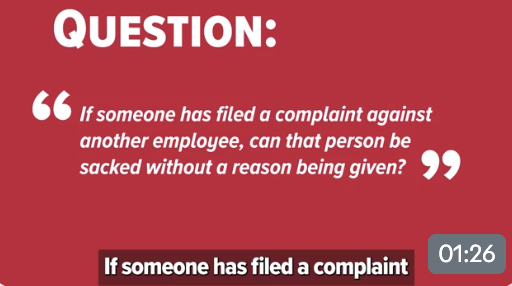
Q1 If someone has filed a complaint against another employee, can that person be sacked without a reason being given?
No.
So if you’re in the unfortunate situation where a complaint has been filed against you, your employer has an obligation to investigate the complaint before taking any disciplinary action against you, including the termination of your employment. If your employment is ended and you’re not given any sort of reason, then you probably have a pretty strong, unfair dismissal claim and you should contact us about that.
And presumably even more so round the other way, just in case the person being talked about is the complainant. If you’ve made a complaint about someone, it’s equally bad if you get if you’re, dismissed. Right?
Right. Sorry, I think I may have misunderstood. If you make a complaint about someone and your employment is then terminated, then you probably have, a claim under the Fair Work Act that I spoke about earlier being a general protections claim. We would have to show that the reason that you were terminated was because you made a complaint. But in a context where you make a complaint and then a week later, you’re, terminated from your employment without being given a reason. There’s normally a pretty strong argument that the reason for the termination is because you made the complaint. Yep. So no matter which person you are in that situation, you should, contact your union/definitely get in touch.
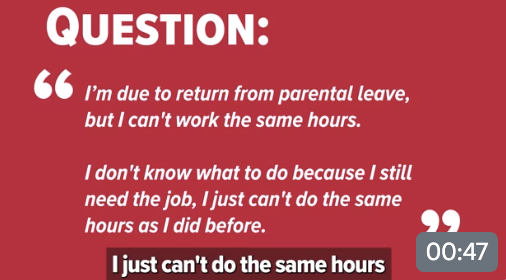
Q2 – I’m due to return from parental leave, but I can’t work the same hours. I don’t know what to do because I still need the job. I just can’t do the same hours as I did before.
So you can absolutely, make a request for flexible work, to return to work part-time, for a period of time, or, a longer period of time as well. So you can make that application to your employer at the same time that you, go on parental leave, or during your parental leave as well. Oh, great. So, yeah, then you can have it all organized for when you get back, and you don’t have to stress about it! Yeah. But also similarly, you might not know, if, you know, if you want to work two days or three days or four days, at the time that you’re applying for your unpaid parental leave, you may only realize that, a few months before you’re due to go back to work. So you also don’t – you can make that application while you’re on your unpaid parental leave as well.
Q3 – What happens if parental leave is refused?
I’m so sorry. This is going to depend, entitlement to unpaid parental leave. The 12 months of unpaid parental leave is an entitlement under the National Employment Standards. And what that means is it is a minimum entitlement for employees in Australia, and it can’t be refused or denied. And if it is, that’s a breach of the Fair Work Act and you should definitely contact us. There may be situations where it’s refused with reason, so there might be some sort of disagreement about whether or not you have had 12 months continuous employment with your employer, or if you’re a casual employee, your employer might say that, well, you haven’t been working on a regular and systematic basis for 12 months, and so you’re not eligible. Or there might be disagreement that you didn’t provide the relevant notice period in writing. In those situations, you should come to us for advice. But we will look at that.
And if we determined that there are grounds, well, that the reason for refusing it wasn’t legitimate, or wasn’t well-founded. Then there are grounds to file a claim, alleging that your employer contravened the Fair Work Act and the National Employment Standards, and there are really big penalties. That can apply when an employer does that. So a breach of the national employment standards, is liable to large fines being paid of up to $93,900 per corporation. That amount is rarely awarded. That’s the maximum. But you can see that, it’s taken really seriously by the courts. As it should be.
Q4 – How much notice do I need to give when applying for parental leave?
So, when I’m answering these questions, I’m talking about your entitlement to unpaid parental leave under the Fair Work Act. The notice requirement for that is ten weeks, and you should provide the request in writing, and you should state the start and finish times of your leave. And how long you want to take. If you can’t give ten weeks notice, you can give a shorter amount of notice as long as you do it as soon as reasonably practicable. So an example of where someone may not give ten weeks notice, is where they end up, giving birth really early, unexpectedly early. And so they had big plans to put in their their ten weeks notice, and all of a sudden they’ve actually given birth, eight weeks before their due date. And in those situations, it’s not expected that you can go back in time and give ten weeks notice. You just have to make sure you give notice as soon as you can about your intention to take unpaid parental leave. You may separately have entitlements in your contract of employment or your enterprise agreement for paid leave from your workplace. Your contract or enterprise agreement will set out the specific notice requirements for your paid parental leave entitlements. And if you need advice on the contract or the enterprise agreement, you can come to us.
Q5 – In terms of the gender pay gap, is there any intention to look at the animal care or vet award? The award is really vague. So employers try to implement clauses that don’t seem fair and the wages are impossible to live on.
This is a really good question. I hope so. So what I do know is that the Fair Work Commission has initiated its own inquiries into certain awards. So early childhood education and care, health professionals, disability support and care, and the pharmacies award, those have recently concluded. But there was an indication that that was a first round and that other awards would be considered. We just don’t know what those awards will be or when the Fair Work Commission will look at them. There were two reports, large research reports that were issued by the Fair Work Commission. Addressing that question I spoke about earlier around gender segregation in the workforce. And certainly, there are aspects of animal care and the vet award where certain, professions and positions within that award are highly feminized. And that means that, you know, over 80% of people working in those roles are women. So I hope that it will be I don’t know yet. But I also think it’s really important that I do acknowledge that we have an election coming up. These inquiries have come off the back of changes that the Albanese Labor government has introduced into the Fair Work Act. If we have a change of government, we don’t know, how many of those changes will be preserved or not. And, you know, there is a risk that those inquiries don’t don’t continue.
Q6 – Okay, another one around Flexible Working Arrangements. Do employers have to approve or, you know, I guess – what’s the threshold for them being allowed to deny a request?
So they can deny a request on, reasonable business grounds. There’s going to be no argument about what that means. And, like I said, if they’re going to refuse it, they have to be able to show that they’ve genuinely tried to reach agreement with you.
On alternative arrangements. If the original arrangement you proposed wasn’t suitable. But it can be. It can be refused if it’s not reasonably possible for your employer, to accommodate your flexible working hours. And, like I said, if your application for flexible working hours is refused, we can dispute that in the Fair Work Commission and I think that often the idea of reasonable business grounds is, exploited by employers as a catchall excuse to not grant flexible working arrangements. And so, more often than not, we can challenge those.
Download the presentation
Download the slide deck from this workshop as a PDF